Showing posts with label Barcelona. Show all posts

Tuesday, 25 June 2013

Guardiola's next chapter begins


After a record-breaking, treble-winning season, it should be nigh on impossible for Bayern Munich's year to get any better; there is, if any at all, minuscule room for improvement. Although, as every fan of football knows, miracles do happen, and success can in fact be built upon when the odds are stacked against such an act.

Bayern Munich's potential improvement comes in the form of a certain man, sent from the football heavens, a man who world football has missed considerably over the last season. A slim, suited figure with a famously charismatic presence, his appearances in front of an audience have been limited and treasured over the last 12 months, and any public sightings of him have been photographed, documented and circulated. 

Pep Guardiola has been little more than an enigma since his voyage with Barcelona came to an end last May - the Catalan stepped ashore, leaving a fairy tale adventure behind, and disappeared into a crowd, off to experience life for a year as a mere mortal, away from the external pressures football brings. 

A rare video of him would appear on the Internet, or he would emerge from the shadows for a brief moment at a glittering event; most of the time, however, Guardiola has simply been the word on people's lips, or printed text in newspapers. Even when he was announced as Jupp Heynckes' successor in January, he made no song or dance about it; the media did that for him. 

Partly, this is because the Spaniard is renowned for being so humble, often preferring his football to do the talking rather than his own choice of words. However, words were what he had to use on Monday; and, as expected, they were spoken in German. 

His first press conference as the head coach of Bayern Munich did not have to be very long, as it was heavily laden with carefully chosen, persuasive words, aimed at winning over the German press. And it is worth knowing that Pep Guardiola is very good at winning, had you not realised already. 

As a result of his entrance, Guardiola was greeted by an orchestra of camera shutters being repeatedly and obsessively snapped shut, as over 250 journalists and reporters forced themselves inside the Allianz Arena to witness Barcelona's saviour share precious words with the world, flanked by Bayern's hierarchical threesome of club president Uli Hoeneß, chief executive Karl-Heinz Rummenigge and sporting director Matthias Sammer. "Please forgive my German," the Catalan modestly began, "I lived in New York last year - not the ideal place to learn." 

What ensued was a captivating press conference that revealed Guardiola was being rather hard on himself; his German was fluent and exceptional. He looked every part the head coach of Bayern Munich, as his calm nature and professionalism drew those around him into a state of awe, something he has easily done on the past. 

However, the press conference switched to a serious tone with a swift alteration of topic and a newly learned German accent. When considering his approach to the job, Guardiola explained how his aim is "to change a few things, but still maintain the high level that the team has". Therefore, while many questioned if the current superstars would buy into the 42 year-old's philosophies, it is in fact the opposite which shall be occurring; he shall be building on what has made Bayern Munich successful, as he mentioned on Monday. Not the other way around. 

This willingness to adapt is what will make the Catalan a better coach as he moves from club to club. He may be likely to implement a high-pressing game into Bayern's style, as well as adding a few other traits, however he has been watching the Germans' matches while in New York for a reason: bar the odd correction, he shall be taking the old 'if it ain't broke, don't fix it' approach to his coaching of the Bundesliga champions once pre-season kicks in. 

Despite his solitary portrayal, the Catalan has never and will never succeed on his own. Once he is consistently back out on the training ground and spending hours in his office, support is integral; he always needs his coaching team in the background, his own personal set of shadows to follow him wherever he goes, sharing the same thoughts and determination, and always being on the same wavelength. 

Domènec Torrent and Carles Planchart have assisted Pep from the depths of Spanish football in 2007, when he took charge of Barça B and won promotion to the second tier, and it makes perfect sense for him to hire them for his tenure at Munich considering they were constantly in the background at the Camp Nou. While Planchart shall analyse opposing teams, Torrent will act as Guardiola's assistant alongside Hermann Gerland, a familiar face at the Bavarian club since 2001 as coach of the B team. His experience and knowledge is what Guardiola shall turn to when considering the development of Bayern's youth system and integrating the academy's players into the first team, a sustainable tactic which paid off at Barcelona. 

Lorenzo Buenaventura was brought to Catalonia by Guardiola in 2008 as the first team's fitness coach and subsequently shaped Europe's most wondrously persistent team by conditioning the squad into intense pressers of the ball, an integral tactic of Pep's Barcelona that will likely be seen in Bayern's play over the next few years.

Manuel Estiarte, an Olympian who won a gold medal for water-polo, is a close personal friend of Guardiola and will become a known face at the club. Estiarte has been immensely supportive for the 42 year-old in the past, especially when the Catalan underwent a traumatic ordeal and was mistakenly banned for alleged doping in 2001, while in Italy. The suspected chemical found in Guardiola's body was later found to be natural, and he was cleared in 2007. 

It could be said that Guardiola's plans for the near future are already planned out as near to perfect as they can be; and the manner in which he went about his first appearance as coach of Bayern Munich only supports this. There will, of course, be variables, and obstacles that stand in his way. Many factors have the potential to not comply with common fantasy; after all, he does not understand the DNA of the Bavarians in the same way he did at Barça, after spending nearly two decades there as a member of La Masia and senior player prior to his managerial stint.

Problems like, for example, whether or not he has the freedom he wishes with transfers could stand in the way of progress. His ability to build on near-perfection is also something that has rarely been tested; he has maintained it, yes, but with Barça B as well as the first team, he took over a squad of players spiralling out of control due to mismanagement and a lack of discipline. 

Only the football matches that the future holds will determine whether or not Bayern Munich will maintain and somehow build upon the immense success the club has recently experienced as they enter Guardiola's era; however what is certain is that, as the ship has already set sail, it is quite simply going to be a spectacular journey. 

Monday, 8 April 2013

Abidal returns on a long night for Mallorca


FC Barcelona 5 - 0 RCD Mallorca


DESPITE the humidity in Catalonia on Saturday evening, it rained goals as Barcelona watered down Gregorio Manzano's Mallorca side and French defender Eric Abidal returned to a hero's welcome at the Nou Camp. 

The Frenchman had not played for Barcelona's first team since February 2012, following the announcement of his pending liver transplant. Remarkably, the defender is playing football once again when many feared he would be unable to continue. After utilising the B team to return to complete match fitness, Abidal nervously filled in at centre-back after replacing Gerard Pique on the 70th minute, and his initial touches and passes were celebrated by the crowd who were witnessing an inspirational, emotional and unique comeback in the world of sport. 

Tito Vilanova, another recent absentee, returned to the managerial area of the welcoming Nou Camp for the fixture against Mallorca, who are grounded at the foot of La Liga. Deportivo de la Coruna's third successive win on Saturday evening propelled them from bottom place, leaving the islanders rather stranded. 

As expected, the intentionally weakened Barcelona, who lacked the injured Messi and therefore played Cesc Fábregas at centre-forward, had one eye on the Champions League quarter-final home tie against Paris Saint-Germain on Wednesday. They found their feet early on and began overwhelming their opposition with the hypnotic tiki-taka that the omniscient, current generation is well-known for. Mallorca's defence, notably the club captain José Nunes, put up a feeble attempt at halting the rhythmic tidal wave that is Barcelona's attack. 

In the first half, Andres Iniesta, as usual, played with such urgency that he does in any football match, regardless whether it is a world cup final or a match against the bottom of Liga Primera; and, with the space Los Bermellones gifted la Blaugrana in both midfield and attack, Iniesta played with evident, determined freedom. Like an animal released from its cage, the captain on the evening savoured every moment on the pitch, and was later subject to a standing ovation as he was substituted. 

However, the goals came from the outstanding combination of Cesc Fabregas and Alexis Sanchez. The first, on the 20th minute and courtesy of the ex-Arsenal skipper, was completed once he played a one-two with his Chilean counterpart, leaving Nunes marking thin air and, ultimately, the ball rolling to a halt in the netting of Mallorca's vulnerable goalposts. The two then traded occupation moments later as Cesc's shot rebounded off the sorrowful goalkeeper, Dudu Aouate, into the path of Sanchez, who subsequently secured his name on the score sheet and effectively drowned any chances Mallorca had of taking any points from Catalonia. 

The ebb and flow of Barcelona's attack resulted in a further first half goal, when Fábregas commissioned his second give-and-go with Sanchez, floated through the Mallorca defence, reclaimed the ball and finished with style past the goalkeeper, who could do little to prevent the inevitable outcome.

Once again, two minutes later, Sanchez followed suit, bursting into the box as his telepathic, in-form colleague Fábregas floated a lengthy pass directly into the Chilean's path. Nunes, unsurprisingly, made no intervention whatsoever to prevent the ball ending up the goal - which was exactly what happened, rounding off the first half's goals five minutes before the break.

Dani Alves' efforts in the first half, which carried on for the majority of the match, were outstanding. The Brazilian was constantly looking out for one-twos, making crosses, cutting inside and bombarding up the right-hand side of the pitch with the speed and determination of an overflowing, raging river.

Cristian Tello, additionally, made a positive impression upon those watching due to his linking up with Iniesta both inside of Mallorca's box and around it; his spatial awareness and his willingness to chase every ball down gained him a fair amount of praise as he integrates himself into the first team. 


Eric Abidal's return to first team football at Barcelona is a miraculous one, and one which will inspire countless athletes across the vast sporting world

Although, after the final goal of the game was crafted one minute after the restart and Fábregas' first ever league hat-trick was complete, the pace did significantly slow and the creativity of the substituted Iniesta was missed. Barca still created chances at will, of course, and this was down to the fact that the resigned Mallorca had finished digging their own grave and were rather happy to clamber into it, lie down and wait for the final whistle. 

Ultimately, it was a simple encounter for Barcelona and a nightmarish one for Mallorca. Nunes' ears are most likely still ringing from the telling off he will undoubtedly have received from Gregorio Manzano, whereas Barcelona’s second string carried out their instructions well, paving the way for Wednesday’s Champions League adventure.

Should Lionel Messi not be fully recovered in order to face Carlo Ancelotti's PSG on Wednesday, both Sanchez and Fábregas can rightly claim a place in the starting eleven who will be fully motivated by the reassurance and discipline of having their leader Tito Vilanova growing in strength.

La Blaugrana, with two away goals and hosting the second leg, have a significant chance of progressing into the semi-finals of the Champions League should they seize the opportunity and submerge their opponents with their frequent briliance. With the determination of Zlatan Ibrahimovic to overhaul Vilanova’s side for previous disagreements, it may be an incredibly tight match; however, the odds are certainly in Barcelona’s favour.  


Wednesday, 3 April 2013

The power of the supporter is the saviour of Spanish football


Spain has an unwavering obsession with football: especially its own. Barcelona and Real Madrid, the crown jewels of the country’s favourite sport, undoubtedly epitomise what every football club in the world aspires to be, paving the way in terms of status and superiority. On top of this, they manage their fierce political rivalry, which passionately divides Spaniards.

National best-selling newspapers like Marca and El Mundo Deportivo, based in Madrid and Catalonia respectively, reflect the country’s obsession with the beautiful game, and further encourage the divide between clubs and fans. Such rivalry on this scale is daunting for those unfamiliar with it; however, in a country where fans take the wrong approach, supporting either Barcelona or Real Madrid no matter where their birthplace happens to be, it is at least understandable.

Compared to the English Premier League, La Liga revels in its own creations. Guillem Balague, critically acclaimed author of Pep Guardiola: Another Way of Winning and respected Sky Sports La Liga pundit, remembers Barcelona fielding a full starting eleven against Levante in November who were all "products of the club's youth system". The famed academy's emblematic vicinity is La Masia, the converted farmhouse located meters from the Nou Camp. Athletic Bilbao, one of the oldest football clubs in Spain, shares a similar attitude to producing adept, shaped footballers, nurturing them in their Lezama facilities.

"We have the aim," says a source at Athletic, "to play with players formed in Lezama. Other clubs can complete their teams with players coming from abroad, but youth development is a need in our case." Additionally, Guillem recognises that as many as "16 clubs in La Liga are effectively bankrupt," and so it becomes clear that, ultimately, youth development is a necessity for many like Athletic.

In the grander scheme of things, the weekly excellence of the Barcelona players or the fast feet of Cristiano Ronaldo are insignificant. La Liga’s playing style and prominence is idolised around the world; although, internally, the mismanagement of financial affairs has written the league's own suicide note and threatens to grind the glowing life from Spanish football with its bare, skeletal hands. The star players that the uniquely dominant La Liga can attract, create and can afford are simply the bricks and mortar which has constructed the palace of Spanish football. Said palace, however, is crumbling.

Does Balague believe there is a bright future for Spanish football? "Absolutely not," he declares. "Many clubs are up the creek without a paddle. Real Madrid and Barcelona cream off around 50% of the media money available, leaving the rest of the league to scrap about for whatever crumbs are left on the table."

La Liga's debt is hovering around the €3.5bn mark, with the two top leagues in Spain owing approximately €750m in taxes. These figures have been at crisis point for some time, partly due to the unequal share of television rights. As expected, Los Merengues and El Blaugrana again claim around 50% of the current television rights divide, earning €140m each.

Financially, Real Madrid and Barcelona dominate world football - their annual turnovers dwarf that of any other club

The Deloitte 2013 Football Money League analyses the complete income and revenue of the world’s largest clubs, recognising Real Madrid and Barcelona as the top two institutions, who raked in €512.6m and €483m respectively in the 2011/12 campaign alone. In fact, Jose Mourinho’s Blancos became “the first sports club to surpass the €500m revenue threshold in a single year”, according to Deloitte’s report. Both clubs’ budget is reflected in this turnover as Richard Fitzpatrick, author of the outstanding El Clásico, points out: “La Liga is crippled by the Barcelona/Real Madrid duopoly, which stifles other clubs in Spain; for example, Rayo Vallecano’s budget this season was €7m compared to the €500m that both Real Madrid and Barcelona had to spend.”

Richard and Guillem demonstrate a shared astuteness about how exactly they believe the future of La Liga will pan out. “I think La Liga will become a satellite league.” says Fitzpatrick; and it will soon become clear why. According to Guillem, Barcelona and Real Madrid will most likely end up “playing in some multi-billion pound European league funded by the world's super corporations while the rest of the clubs go to the wall”. Sadly, for the well-being of smaller clubs around the world, this does not look promising. Richard develops on this, explaining how he believes there is “an inexorable push towards a Super European League with, say, four Spanish teams qualifying every season”. With other European giants likely to join said 'Super League', set to become the spoilt brat of a love-child of the money-centred farcical organisations which control world football, a devastating period of neglect shall be inflicted upon the clubs left behind.

Now, where does all of this actually leave Spanish football?

Spain's leading football economist and economics professor at the Universidad de Barcelona, Jose Maria Gay de Liebana, predicted last September that Spanish football will “kill itself” in the dauntingly near future. “A year ago, I predicted that La Liga had ten only ten seasons left, now I see that five more would be a lot.” Prophetic? Undoubtedly. And hauntingly so.

Ever since Pep Guardiola, the iconic Catalan, introduced his innovative pressing game to Barcelona back in 2008, teamed with the famed tiki-taka style of play, Spanish football has been immensely fashionable. 

The inspirational and catalytic Pep Guardiola made his Barcelona side play beautiful football; in turn, he also inspired the Spanish national team's success

Guardiola's renovation of Barcelona saw him win an unrivalled sextet of trophies in his first full year in charge; and this alerted a certain Vincente del Bosque to take note, leading to the worldwide fascination in and scrutiny of Spanish football. Del Bosque added to Luis Aragonés’ Euro 2008 victory by claiming the 2010 World Cup in South Africa and then, in defiance of his critics, inspired his squad to a successive European Championship title last year.

The significance of this revolutionary playing style and success of the national team is that, the current crop of outstanding players who are either Spanish and play for the national team, or were players under Guardiola, have all contributed to the monstrous rise to worldwide domination from Spain. Therefore, removing Barcelona and Real Madrid especially will vastly contribute to the proposed death of La Liga and inevitable neglect of the smaller clubs. There is also no guarantee that future generations of Spaniards will be of similar calibre to today’s. The identity of Spanish football may well be on the verge of becoming extinct: in its own country.

In mid January, Bayern Munich made the remarkable announcement that Pep Guardiola is to become the club's head coach come the end of the current season. Bayern is a club run similarly to Barcelona, explaining why Guardiola opted for a move to Germany: both are owned by members who are also fans, own impressive youth academies (something which has been enshrined in law Germany’s top two leagues) and are worldwide brands.

Unlike La Liga, debt is not a noticeable issue in the Bundesliga, as fans are valued - not exploited. Season tickets at Munich can be purchased for as little as €100 and average attendances in the whole of Germany embarrass England, Italy and Spain.

Hans Joachim-Watzke, the CEO of Borussia Dortmund, sees importance in treating the average German supporter correctly 

The Borussia Dortmund CEO, Hans-Joachim Watzke, recently told FourFourTwo that “if you tell a German fan he is just a customer, he is going to kill you”. Christian Seifert, the Bundesliga chief executive, believes that the success of the German top flight is due to the “core value” of the supporter and their importance at every club, hence the affordability of tickets. Team this with the dwarfing average attendances, youth dependency, the ‘50 + 1 rule’ (which consists of members having to own at least 51% of a club so that a single entity cannot take control), clubs paying less than 50% of their revenue on player wages and the sheer attraction of football quality to the fans, and it is clear to see why the Germans can breathe easily, creating a yearly turnover of around €2bn with small annual losses now and again (two since 2003).

In the land where the fan is the king of the castle, Guardiola is about to unleash the Spaniard, the Catalan,inside him; this may be the first of many examples to come, but the Catalan's introduction to German football is where the external redemption of Spain will begin.

“I think he will bring his pressing game to Bayern Munich,” says Richard Fitzpatrick. “But not so much of the tiki-taka unless he buys Pique to bring it out from the back, Sergio [Busquets] and Iniesta.” It is,however, rather unlikely the trio will be moving to accompany Guardiola. He shall have to adapt to Germany's differences, as well as keeping his core, Spanish orientated beliefs, potentially becoming a pioneer as the first landmark prophet of Spanish football.


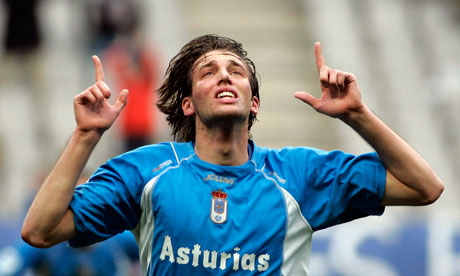
The financial resurrection of Real Oviedo was aided by former players, like Swansea City's Miguel Michu (above), who gifted a portion of their own money to help rescue the club from liquidation

Of course, while Guardiola ventures to other lands for his own expedition, Spain is still left to stagnate; and this is where remarkable tales, such as that of Real Oviedo, need to become more frequent. The experience of the Oviedistas came to light in November of last year, when the club’s president began enquiring about the details of liquidation. The club may presently find itself in the third tier of Spanish football, however they are looking ambitious and resurrected: thanks to a cluster of English Premier League players, the richest man in the world and, of course, their fans.

Since relegation from La Liga in 2001, Real Oviedo have never gone under 10, 000 season ticket holders; something which only two other teams outside of the top flight can boast. Therefore, a respected fan base is more likely to aid clubs in times of desperation. Add this to the fact that Premier League trio Miguel Michu, Juan Mata and Santi Cazorla, who have all played for Oviedo, gave money from their own pockets to help out, and you have a redeeming formula.

It also drastically relieved tensions when the richest man in the world, Mexican Carlos Slim (worth £43bn through his telecommunications company), bought a stake in the club worth under £1.6m, hauling the club from death’s door, feeding it a much needed meal or two, and forcing it through rehabilitation.

Naturally, other factors aided Real Oviedo in their rise from the depths, but their supporters are worthy of , the fans are the “core” of football. The small Spanish club may be eons away from the bright lights of Bayern Munich; however its story is an example to all of Spanish football.

Alter your attitude towards the fans to that of the German culture, and reap the rewards come Judgement Day. Whether or not the Spaniards will take note of what is staring them in the face, however, is another issue.

After all, the potential exists: Spanish football can be rescued from the looming abyss of its widely prophesied fate, avoiding the perils of its own creation. Although, this will only occur should they be acknowledged and amended.

And it is all down to those who are ready and willing.