Spain has an unwavering obsession with football: especially its own. Barcelona and Real Madrid, the crown jewels of the country’s favourite sport, undoubtedly epitomise what every football club in the world aspires to be, paving the way in terms of status and superiority. On top of this, they manage their fierce political rivalry, which passionately divides Spaniards.
National best-selling newspapers like Marca and El Mundo Deportivo, based in Madrid and Catalonia respectively, reflect the country’s obsession with the beautiful game, and further encourage the divide between clubs and fans. Such rivalry on this scale is daunting for those unfamiliar with it; however, in a country where fans take the wrong approach, supporting either Barcelona or Real Madrid no matter where their birthplace happens to be, it is at least understandable.
Compared to the English Premier League, La Liga revels in its own creations. Guillem Balague, critically acclaimed author of Pep Guardiola: Another Way of Winning and respected Sky Sports La Liga pundit, remembers Barcelona fielding a full starting eleven against Levante in November who were all "products of the club's youth system". The famed academy's emblematic vicinity is La Masia, the converted farmhouse located meters from the Nou Camp. Athletic Bilbao, one of the oldest football clubs in Spain, shares a similar attitude to producing adept, shaped footballers, nurturing them in their Lezama facilities.
"We have the aim," says a source at Athletic, "to play with players formed in Lezama. Other clubs can complete their teams with players coming from abroad, but youth development is a need in our case." Additionally, Guillem recognises that as many as "16 clubs in La Liga are effectively bankrupt," and so it becomes clear that, ultimately, youth development is a necessity for many like Athletic.
In the grander scheme of things, the weekly excellence of the Barcelona players or the fast feet of Cristiano Ronaldo are insignificant. La Liga’s playing style and prominence is idolised around the world; although, internally, the mismanagement of financial affairs has written the league's own suicide note and threatens to grind the glowing life from Spanish football with its bare, skeletal hands. The star players that the uniquely dominant La Liga can attract, create and can afford are simply the bricks and mortar which has constructed the palace of Spanish football. Said palace, however, is crumbling.
Does Balague believe there is a bright future for Spanish football? "Absolutely not," he declares. "Many clubs are up the creek without a paddle. Real Madrid and Barcelona cream off around 50% of the media money available, leaving the rest of the league to scrap about for whatever crumbs are left on the table."
La Liga's debt is hovering around the €3.5bn mark, with the two top leagues in Spain owing approximately €750m in taxes. These figures have been at crisis point for some time, partly due to the unequal share of television rights. As expected, Los Merengues and El Blaugrana again claim around 50% of the current television rights divide, earning €140m each.
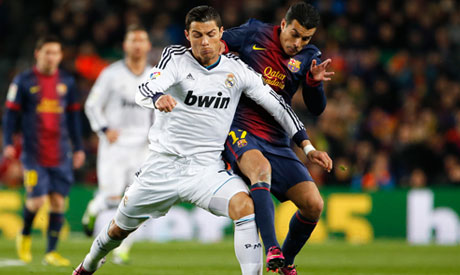
Financially, Real Madrid and Barcelona dominate world football - their annual turnovers dwarf that of any other club
The Deloitte 2013 Football Money League analyses the complete income and revenue of the world’s largest clubs, recognising Real Madrid and Barcelona as the top two institutions, who raked in €512.6m and €483m respectively in the 2011/12 campaign alone. In fact, Jose Mourinho’s Blancos became “the first sports club to surpass the €500m revenue threshold in a single year”, according to Deloitte’s report. Both clubs’ budget is reflected in this turnover as Richard Fitzpatrick, author of the outstanding El Clásico, points out: “La Liga is crippled by the Barcelona/Real Madrid duopoly, which stifles other clubs in Spain; for example, Rayo Vallecano’s budget this season was €7m compared to the €500m that both Real Madrid and Barcelona had to spend.”
Richard and Guillem demonstrate a shared astuteness about how exactly they believe the future of La Liga will pan out. “I think La Liga will become a satellite league.” says Fitzpatrick; and it will soon become clear why. According to Guillem, Barcelona and Real Madrid will most likely end up “playing in some multi-billion pound European league funded by the world's super corporations while the rest of the clubs go to the wall”. Sadly, for the well-being of smaller clubs around the world, this does not look promising. Richard develops on this, explaining how he believes there is “an inexorable push towards a Super European League with, say, four Spanish teams qualifying every season”. With other European giants likely to join said 'Super League', set to become the spoilt brat of a love-child of the money-centred farcical organisations which control world football, a devastating period of neglect shall be inflicted upon the clubs left behind.
Now, where does all of this actually leave Spanish football?
Spain's leading football economist and economics professor at the Universidad de Barcelona, Jose Maria Gay de Liebana, predicted last September that Spanish football will “kill itself” in the dauntingly near future. “A year ago, I predicted that La Liga had ten only ten seasons left, now I see that five more would be a lot.” Prophetic? Undoubtedly. And hauntingly so.
Ever since Pep Guardiola, the iconic Catalan, introduced his innovative pressing game to Barcelona back in 2008, teamed with the famed tiki-taka style of play, Spanish football has been immensely fashionable.
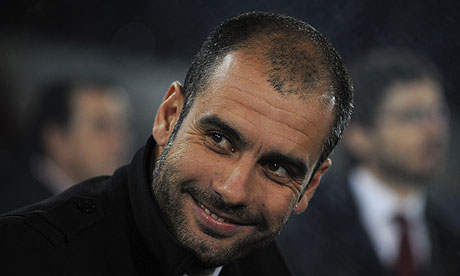
The inspirational and catalytic Pep Guardiola made his Barcelona side play beautiful football; in turn, he also inspired the Spanish national team's success
Guardiola's renovation of Barcelona saw him win an unrivalled sextet of trophies in his first full year in charge; and this alerted a certain Vincente del Bosque to take note, leading to the worldwide fascination in and scrutiny of Spanish football. Del Bosque added to Luis Aragonés’ Euro 2008 victory by claiming the 2010 World Cup in South Africa and then, in defiance of his critics, inspired his squad to a successive European Championship title last year.
The significance of this revolutionary playing style and success of the national team is that, the current crop of outstanding players who are either Spanish and play for the national team, or were players under Guardiola, have all contributed to the monstrous rise to worldwide domination from Spain. Therefore, removing Barcelona and Real Madrid especially will vastly contribute to the proposed death of La Liga and inevitable neglect of the smaller clubs. There is also no guarantee that future generations of Spaniards will be of similar calibre to today’s. The identity of Spanish football may well be on the verge of becoming extinct: in its own country.
In mid January, Bayern Munich made the remarkable announcement that Pep Guardiola is to become the club's head coach come the end of the current season. Bayern is a club run similarly to Barcelona, explaining why Guardiola opted for a move to Germany: both are owned by members who are also fans, own impressive youth academies (something which has been enshrined in law Germany’s top two leagues) and are worldwide brands.
Unlike La Liga, debt is not a noticeable issue in the Bundesliga, as fans are valued - not exploited. Season tickets at Munich can be purchased for as little as €100 and average attendances in the whole of Germany embarrass England, Italy and Spain.
Hans Joachim-Watzke, the CEO of Borussia Dortmund, sees importance in treating the average German supporter correctly
The Borussia Dortmund CEO, Hans-Joachim Watzke, recently told FourFourTwo that “if you tell a German fan he is just a customer, he is going to kill you”. Christian Seifert, the Bundesliga chief executive, believes that the success of the German top flight is due to the “core value” of the supporter and their importance at every club, hence the affordability of tickets. Team this with the dwarfing average attendances, youth dependency, the ‘50 + 1 rule’ (which consists of members having to own at least 51% of a club so that a single entity cannot take control), clubs paying less than 50% of their revenue on player wages and the sheer attraction of football quality to the fans, and it is clear to see why the Germans can breathe easily, creating a yearly turnover of around €2bn with small annual losses now and again (two since 2003).
In the land where the fan is the king of the castle, Guardiola is about to unleash the Spaniard, the Catalan,inside him; this may be the first of many examples to come, but the Catalan's introduction to German football is where the external redemption of Spain will begin.
“I think he will bring his pressing game to Bayern Munich,” says Richard Fitzpatrick. “But not so much of the tiki-taka unless he buys Pique to bring it out from the back, Sergio [Busquets] and Iniesta.” It is,however, rather unlikely the trio will be moving to accompany Guardiola. He shall have to adapt to Germany's differences, as well as keeping his core, Spanish orientated beliefs, potentially becoming a pioneer as the first landmark prophet of Spanish football.

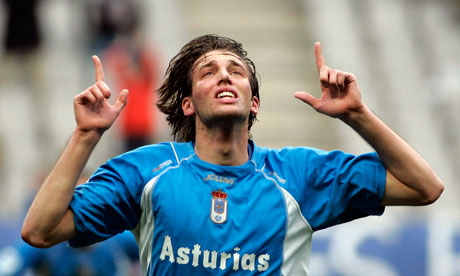
The financial resurrection of Real Oviedo was aided by former players, like Swansea City's Miguel Michu (above), who gifted a portion of their own money to help rescue the club from liquidation
Of course, while Guardiola ventures to other lands for his own expedition, Spain is still left to stagnate; and this is where remarkable tales, such as that of Real Oviedo, need to become more frequent. The experience of the
Oviedistas came to light in November of last year, when the club’s president began enquiring about the details of liquidation. The club may presently find itself in the third tier of Spanish football, however they are looking ambitious and resurrected: thanks to a cluster of English Premier League players, the richest man in the world and, of course, their fans.
Since relegation from La Liga in 2001, Real Oviedo have never gone under 10, 000 season ticket holders; something which only two other teams outside of the top flight can boast. Therefore, a respected fan base is more likely to aid clubs in times of desperation. Add this to the fact that Premier League trio Miguel Michu, Juan Mata and Santi Cazorla, who have all played for Oviedo, gave money from their own pockets to help out, and you have a redeeming formula.
It also drastically relieved tensions when the richest man in the world, Mexican Carlos Slim (worth £43bn through his telecommunications company), bought a stake in the club worth under £1.6m, hauling the club from death’s door, feeding it a much needed meal or two, and forcing it through rehabilitation.
Naturally, other factors aided Real Oviedo in their rise from the depths, but their supporters are worthy of , the fans are the “core” of football. The small Spanish club may be eons away from the bright lights of Bayern Munich; however its story is an example to all of Spanish football.
Alter your attitude towards the fans to that of the German culture, and reap the rewards come Judgement Day. Whether or not the Spaniards will take note of what is staring them in the face, however, is another issue.
After all, the potential exists: Spanish football can be rescued from the looming abyss of its widely prophesied fate, avoiding the perils of its own creation. Although, this will only occur should they be acknowledged and amended.
And it is all down to those who are ready and willing.